Independent, evidence-first technical judgment.
The outside read a team brings in for the calls that are hard to make from the inside: is the claim real, should you build or buy, what should you own, and what is it costing you. Fractional CTO, technical due diligence, and AI cost optimization, from someone who has operated revenue-critical production systems at scale and built the open-source infrastructure the AI ecosystem runs on. Backed by published work and checked on your own systems, not asserted.
 ·
 SDK (Linux Foundation) · 🧠 NeuroNest · and more
New book
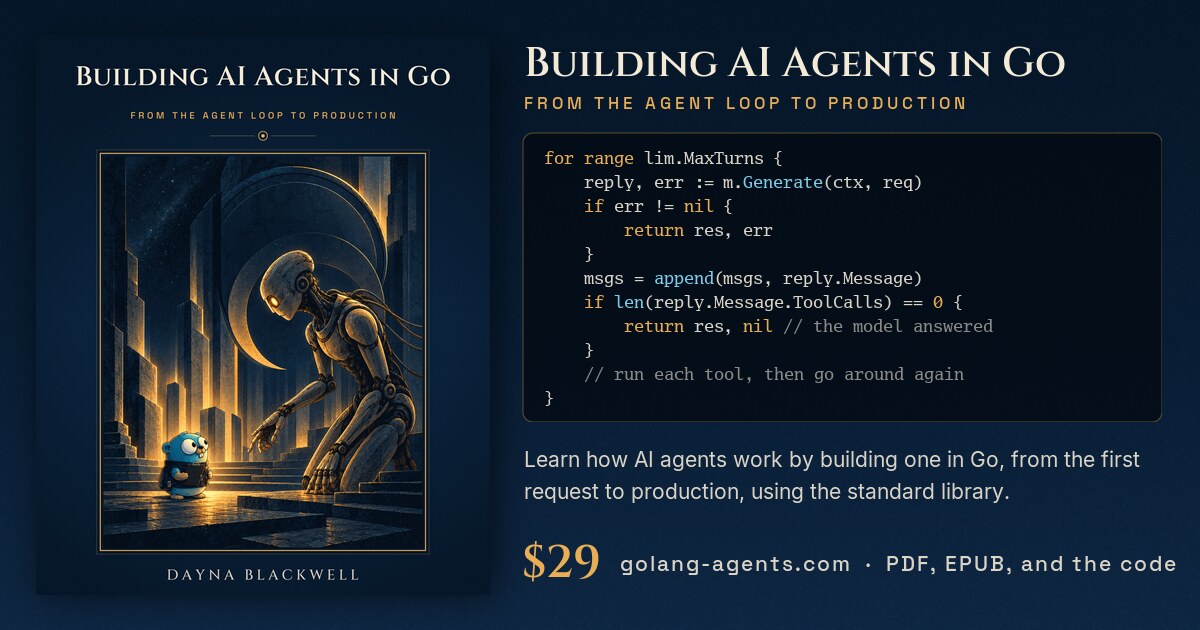
Building AI Agents in Go
From the agent loop to production. Learn how AI agents work by building one in Go, from the first request to production, using the standard library.
Build the loop yourself
Start with a 30-line loop and finish with a crash-triage agent for a real Go web service that reproduces each bug, fixes it, and files one issue per cause. net/http, encoding/json/v2 and context, no framework.
Measured, not asserted
One sentence in a tool description decided the first move in 79 of 80 replies. Parallel agents were no faster than one, at about 25 to 60 percent more cost. 910 crash scenarios, 0 duplicate actions with idempotency keys.
17 chapters, 776 pages
Tool calling, context, streaming, MCP, evals across models, sandboxing and prompt-injection defenses, crash-safe runs. Every example runs offline with no API key. $29, every update of this edition free.
How I work
One method, several ways in
One method underneath everything: evidence-first, verifiable, reproducible, backed by published work and checked on your own data, not asserted. Most engagements start with an assessment and go deep where it points: fractional CTO, technical due diligence, or AI cost optimization.
Fractional CTO
Embedded technical leadership: strategy and roadmap, build-versus-buy and vendor decisions, architecture, engineering process, cost, and the technical narrative for a raise. The judgment a company needs before it hires a full-time CTO.
Technical due diligence
Adversarial, not demonstrative: I define what would prove a claim false, then try. Independent evaluation of a technical claim or vendor, is the advantage real, and should you buy, build, or own it, delivered as a decision memo with economics and risk.
AI cost optimization
Cut your LLM bill without losing quality. A full-stack audit across techniques that compound to 70-90% savings, every number measured on your data.
Run a business and just need a straight answer on AI?
If you are not technical and do not need a CTO, start with the AI Opportunity Assessment: a fixed-scope, vendor-neutral read on where AI actually fits your business and where it does not. It is the front door, and it feeds the three services above when the work is worth it. Plain language, nothing to sell you.
The evidence behind the judgment
Open source infrastructure for the agentic AI stack
The recommendations are backed by shipped, measured work: wire formats, code intelligence, MCP tooling, conformance testing. Everything production-grade, everything backed by data.
GCF (Graph Compact Format)
The AI-native wire format for structured data. 100% LLM comprehension on every frontier model, 90.7% on adversarial payloads. 53-71% fewer tokens than JSON. 2,500+ evaluations across 11 models and 4 providers. Seven implementations, zero runtime dependencies, MCP proxy, 43 billion+ lossless round-trips across 5 formats.
bide
Durable AI agents in Go, with side effects that fire at most once. One append-only journal yields four guarantees no other framework pairs: at-most-once non-idempotent side effects (measured, not claimed), thousands of concurrent durable runs in one process with no cluster, a cryptographically verifiable RFC 6962 Merkle audit trail (checkable offline, no vendor trust), and provably convergent shared state (machine-checked in Coq). Built for agents that move money, touch records, or act under audit.
agent-lsp
Code intelligence infrastructure for AI agents. 65 tools, 30 CI-verified languages, 24 agent workflows. Single Go binary. Uses GCF as default output format.
mcp-assert
Conformance testing for MCP servers. 102 servers scanned, 34 bugs found, 12 upstream issues filed. ~28K downloads. Fuzz testing, schema linting.
knowing
Self-adapting code intelligence engine. 28 MCP tools, graph-native analysis, session deduplication, content-addressed identity layer. The system GCF was extracted from.
GCF Proxy
Wrap any MCP server with one command. JSON tool responses re-encoded as GCF before reaching the model. Zero code changes. Session stats track savings in real time.
GCP Emulator Suite
Local implementations of Google Cloud APIs. Secret Manager has 50K+ downloads, ranked #1 on Google/Bing/DuckDuckGo. KMS, IAM, Eventarc also available.
Upstream
50+ merged PRs across the ecosystem
Most are bug fixes, hardening, and features in open-source projects across the stack. Top-10 all-time contributor to mcp-go.
mcp-go
Top-10 all-time contributor. 9 merged PRs: panic recovery, goroutine-leak fixes, and reliability across the SSE and stdio handlers.
Model Context Protocol
Merged fixes across the official MCP SDKs (PHP, Python, Go): schema corrections, exception chaining, and transport handling.
GitHub
github-mcp-server: co-authored a merged contribution to the official GitHub MCP server.
go-containerregistry: fixed OCI artifact corruption in mutate, added a round-trip test, and corrected registry name parsing.
Grafana
mcp-grafana: a Sift panic fix, timestamp validation, and a feature building server instructions from enabled tool categories.
HashiCorp
terraform-provider-aws: handle the UnsupportedOperationException path in Directory Service so applies stop failing.
Core libraries
Targeted fixes to widely used projects: pip (PyPA) encoding, a testify suite panic, go-openai stream serialization, and a LangChain text-splitter bug.
A service in depth: AI cost optimization
The Token Optimization Stack
Take one of the services in depth. Seven layers of compounding cost reduction, each measured on your own pipeline. They stack multiplicatively: a $2.28 agent session becomes $0.36 after routing, caching, format encoding, and effort control.
Layer 1: Model Routing
Route simple tasks to cheap models (80% savings). RouteLLM, LiteLLM, or custom classifiers. Most teams use one model for everything.
Layer 2: Transport
Prompt caching (90% off repeated prefix), batch API (50% off async work), request coalescing. Zero code changes on Anthropic and OpenAI.
Layer 3: Session
GCF session deduplication: 92% savings by the 5th call. Delta encoding: 81% on re-queries. No other format can do this.
Layer 4: Format
GCF wire format: 53-71% fewer tokens on structured data. 100% LLM comprehension. Drop-in proxy or native encoding in 7 languages.
Layer 5: Context
RAG reranking, CLI output filtering (RTK: 60-90% savings), selective tool loading. Send less irrelevant data into the context window.
Layer 6: Output
Effort parameter (thinking token control), structured outputs, Caveman-style compression. Output tokens cost 3-6x more than input.
Layer 7: Architecture
Agent loop redesign, task budgets, parallel tool execution, progressive disclosure. The loop is where all optimizations compound most aggressively.
AI cost optimization: how it works
The path to permanent cost reduction
A short call, a focused audit, then implementation, measured before and after on every change, in about two weeks.
Step 1: Discovery call (30 min, free)
Eight questions that reveal which of the 7 layers are costing you the most. We identify your batch-eligible workload, cache hit rate, routing opportunities, and structured data percentage.
Step 2: Token audit (1-2 days)
Instrument one representative session. Measure total tokens per call, breakdown by category (system prompt vs history vs tool results vs output), cache hit rate, and structured data ratio. Deliver a report with projected savings per layer.
Step 3: Implement (1-2 weeks)
Deploy optimizations in priority order: prompt caching (day 1), format encoding (day 2), model routing (day 3-4), output compression (day 5), agent loop redesign (week 2). Measured before/after on every change.
30 minutes. We'll show you your actual savings on your real data.
Need an outside technical read?
Whether you want a plain-language read on where AI fits your business, a full-time-CTO-level call, a vendor or claim to verify, or an LLM bill that is too high, the work is the same: independent judgment, backed by published evidence and checked on your own data. Book a call and tell me the question.